
After My Mom's Hip Fracture, I Did BoneFit Training. Here's What Every Person With Osteoporosis Should Know.
Last Updated: June 14, 2026

A little over a year ago, my mom fell while caring for her horses and broke her hip. The DEXA scan that followed revealed osteoporosis.
What came next was harder than the fracture: conflicting information, no real guidance on what exercise was safe, and nothing beyond a prescription. She kept asking the question: What am I supposed to do now?
As part of building Bone-IQ, I did the BoneFit™ training from the Bone Health & Osteoporosis Foundation (BHOF), which is the evidence-based training available for exercise professionals working with people who have low bone density. What I learned are the principles that we’ve incorporated into the Bone-IQ program.
Here are the five lessons I wish every person with osteoporosis or osteopenia knew.
What Is BoneFit Training?
BoneFit™ is a training and certification developed by Osteoporosis Canada and adopted in the United States through the Bone Health & Osteoporosis Foundation. It's designed for physical therapists, exercise physiologists, and other professionals who work with people living with osteopenia or osteoporosis.
The training covers topics from bone biology and fracture risk assessment, to safe movement patterns, falls prevention, resistance training and posture work. It draws on the 2023 Clinical Practice Guidelines for Osteoporosis Management (the most current evidence base in North America) and decades of peer-reviewed research.
If you are interested in BoneFit™, learn more here.
Lesson 1: Walking Alone Isn't Enough
Walking is one of the most commonly recommended exercises for people with osteoporosis, and it's not wrong. Walking is wonderful for cardiovascular health, mood, balance, blood sugar, and sleep and is a great starting point for weight-bearing exercise.
However, bone responds to strain, and walking simply doesn't produce the higher amounts of strain that activities like lifting weights or jumping can.
A meta-analysis of walking-only programs in postmenopausal women found just a 0.4% improvement in spine bone mineral density (BMD) (Martyn-St James & Carroll, Bone, 2008) versus 2.9% in lumbar spine BMD gained in the LIFTMOR intervention group doing high-intensity resistance and impact training over 8 months (Watson et al., Journal of Bone and Mineral Research, 2018).
The 2023 Clinical Practice Guidelines are clear on this: walking should be done in addition to, not instead of, resistance and balance training.
Lesson 2: Strength Training for Osteoporosis is Highly Specific
To build bone strength, you need load.
The guidance from BoneFit™ specifically states:
At least 60% of your one-rep max (1RM) is the minimum stimulus to drive strength adaptation
8–12 reps per set before form starts to fail
2–3 sessions per week, with 24–48 hours recovery between same-muscle-group sessions
Lifting weights that are too light (which is what most fitness classes default to with the 50+ demographic) builds endurance, not strength. The LIFTMOR Trial (Watson et al., Journal of Bone and Mineral Research, 2018) showed that even women with osteoporosis can safely tolerate higher-intensity resistance training under supervision, and the results on bone density were striking.
This is also where the four pillars of bone-health exercise plan come in. BoneFit™ recommends stacking:
Progressive resistance training — to load bone and build muscle
Balance training — to challenge stability and reduce falls
Functional training — for the real-world movements you do every day
Postural training — to keep your spine aligned and protect your vertebrae
Walking is good. Yoga or pilates can be beneficial when done safely. But none of those alone replace this stack. All four pillars work in conjunction to build strength and reduce fall and fracture risk.
Lesson 3: How You Bend Matters
One of the biggest revelations from BoneFit was that most spine fractures don't come from falls or accidents.
Over 60% of vertebral fractures happen spontaneously! This can be from lifting groceries, bending forward to load the dishwasher, or even a hard cough or sneeze. Many are silent: they show up only as gradual loss of height, a forward curve in the upper back (kyphosis), or new mid-back pain.
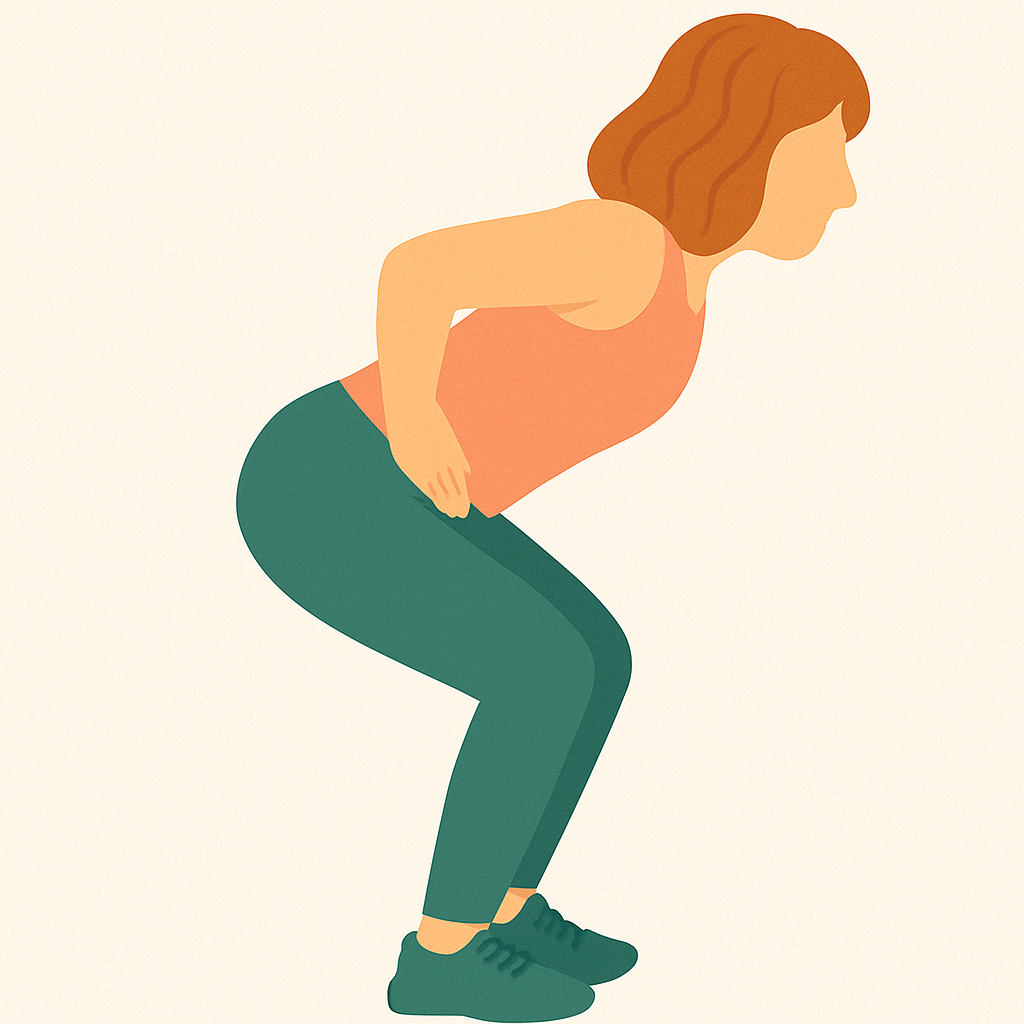
That means the way you move in everyday life matters more than what you do at the gym. BoneFit teaches a set of "spine-safe" movement adaptations:
The hip hinge — bend at the hips, not the spine. Push your hips back, soften your knees, keep your chest tall. Use it for picking up groceries, loading the dishwasher, tying your shoes.
The modified golfer's reach — for one-handed pickups, hinge from one hip and let the opposite leg float backward as a counterweight, keeping your spine long.
The log roll — to get out of bed without flexing your spine, roll onto your side as one unit before pushing up.
These small habits, repeated thousands of times a year, are some of the most powerful fracture-prevention tools available. They don't cost anything. As you practice them, they will just feel natural.
Lesson 4: Balance Training Has Four Distinct Types
If you've ever stood on one foot while brushing your teeth, you've trained one type of balance. But there are four:
Anticipatory control — shifting your weight before a movement (reaching, stepping)
Dynamic stability — heel raises, sit-to-stands, tandem walking
Functional stability limits — how far you can lean or reach without losing balance
Reactive control — recovering from a stumble, push, or unexpected nudge
Most balance programs train only the first two. Reactive control, or practicing how to recover when you're surprised, is the one most people skip, and it's arguably the most important. It's what saves you when you slip on a kitchen rug or get bumped on the sidewalk.
Research from Sherrington and colleagues (British Journal of Sports Medicine, 2016) found that for balance training to actually reduce fall risk, it needs to total about 3 hours per week and be challenging enough that you feel slightly unsteady.
Lesson 5: A Hip Fracture Isn't Just a Broken Bone
This lesson was the scariest for me.
Up to 20% of older adults die within one year of a hip fracture, and roughly half of survivors never regain prior independence (BHOF; International Osteoporosis Foundation). About 80% of hip fractures are linked to osteoporosis, and 90% involve a fall.
The good news however: hip fractures are largely preventable. The direction of the fall, the bone density at the femoral neck, soft-tissue padding, reaction time, footwear, or even lighting in the home are all modifiable influence factors.
Falling sideways onto the hip is 6 to 20 times more likely to cause a fracture than falling in another direction (Greenspan et al., JAMA, 1994). That's why lateral stability training and reactive balance work (the kind that BoneFit emphasizes) matter so much. You can't always prevent a fall. But you can train your body to land better.
What This Means for You
If you or someone you love has been diagnosed with osteopenia or osteoporosis, here's the takeaway: a diagnosis is information, not a sentence. Bone tissue responds to load, nutrition, alignment, and consistent training, and you can start at every age!
The challenge is knowing how to start. What movements are safe? What load is enough? What should you avoid? How do you progress? Most patients leave their doctor's office with a prescription but no plan for all the things that can be done at home.
That's the gap we built Bone-IQ to close. It’s an app that meets you where you are to start strength training and progresses with you.
If reading this made you wonder whether your current exercise routine is actually building bone, it's worth a closer look.
Frequently Asked Questions
What is the best exercise for osteoporosis?
There’s no one best exercise for osteoporosis. The best program is a combination of progressive resistance training, balance work, functional training, and postural training per the 2023 Clinical Practice Guidelines for osteoporosis.
Can you reverse osteoporosis with exercise?
Exercise alone usually can't return bone density to "normal" levels, but it can slow loss, preserve density, and meaningfully reduce fracture risk. Combined with adequate nutrition and medication (if prescribed), exercise is one of the most powerful tools in osteoporosis management.
What exercises should be avoided with osteoporosis?
Exercises and daily movements become risky when they involve forceful, repetitive, weighted, sustained, or end-range spinal flexion (forward bending), rotation, or side bending. Crunches, sit-ups, toe-touches, and twisting machines are common examples. Instead, learn the hip hinge and modified golfer's reach for everyday tasks.
Is BoneFit certification recognized in the United States?
Yes. BoneFit was originally developed by Osteoporosis Canada and is offered in the U.S. through the Bone Health & Osteoporosis Foundation (BHOF). It is a specialist training available for professionals working with osteoporosis clients.
How long before I see results from an exercise program?
Strength and balance gains can start to appear in a few weeks. Bone density changes take months to years. The 2023 Clinical Practice Guidelines recommend at least 12–16 weeks of consistent progressive resistance training before reassessing. Consistency matters.
Lexi Lewis is the co-founder of Bone-IQ. Read more about our story or download the Bone-IQ app to start your personalized plan.
Sources
Bone Health & Osteoporosis Foundation (BHOF) — BoneFit Specialist Training
Morin SN et al. Clinical practice guideline for management of osteoporosis and fracture prevention in Canada: 2023 update. CMAJ. 2023;195(39):E1333–E1348.
International Osteoporosis Foundation — patient education and global epidemiology.
Martyn-St James M, Carroll S. Meta-analysis of walking for preservation of bone mineral density in postmenopausal women. Bone. 2008;43(3):521–531.
Watson SL et al. High-Intensity Resistance and Impact Training Improves Bone Mineral Density and Physical Function in Postmenopausal Women With Osteopenia and Osteoporosis: The LIFTMOR Randomized Controlled Trial. Journal of Bone and Mineral Research. 2018;33(2):211–220.
Sherrington C et al. Exercise to prevent falls in older adults: an updated systematic review and meta-analysis. British Journal of Sports Medicine. 2016.
Greenspan SL et al. Fall severity and bone mineral density as risk factors for hip fracture in ambulatory elderly. JAMA. 1994;271(2):128–133.