
Exercises to Avoid with Osteoporosis (And What to Do Instead)
Last Updated: June 28, 2026
If you've been diagnosed with osteoporosis or osteopenia, you've probably been told to "be careful.” But what does that really mean? The advice is usually vague, sometimes contradictory, and almost never specific to the movements you actually do every day.
Let’s dive in to learn how to “be careful” based on recommendations from the BoneFit™ specialist training, the standard reference for exercise professionals working with people who have low bone density, and from the 2023 Clinical Practice Guidelines for Osteoporosis Management.
The good news is that once you understand the principles, you'll know what exercises are safe to do and how to incorporate safe movement patterns into your every day life.
Why Some Exercises Are Risky with Osteoporosis
To understand which exercises to modify, it helps to know what makes a movement risky in the first place.
Over 60% of vertebral fractures happen spontaneously, meaning without a fall, and can happen from everyday movements like lifting groceries, bending forward, or even a hard cough. The mechanism is often repeated or end-range spinal flexion, rotation, or side bending, especially under load.
This means the way you move at the gym, in yoga class, and at home all matter. A poorly executed sit-up, a deep forward fold, or a weighted twist can create the exact loading pattern that wedges a weakened vertebra.
The 5 Movement Patterns to Limit
BoneFit summarizes risky spinal movement into five patterns. Spinal flexion (bending forward), rotation (twisting), and side bending become risky when they're:
Rapid or forceful
Repetitive
Weighted or loaded
Sustained
Taken to end-range — or any combination of the above
Some examples of higher-risk movements would be sit-up sets, deadlift with improper form (i.e. a rounded back), or holding a deep forward fold in yoga.
Here's how that translates into specific exercises to modify.
Exercises to Avoid (And What to Do Instead)
1. Sit-Ups and Crunches
Why to avoid: Repetitive spinal flexion. That is exactly the pattern most associated with vertebral wedge fractures.
Do instead: Dead bugs, bird dogs and planks. These train the same core muscles (and more — they hit the deep core and back extensors) without flexing the spine.
2. Toe Touches and Forward Folds with Straight Legs
Why to avoid: Maximum end-range spinal flexion with the entire upper body acting as a lever on a weakened vertebra. This pattern shows up in everyday life (picking up groceries, tying shoes) and is the leading mechanism of "silent" vertebral fractures.
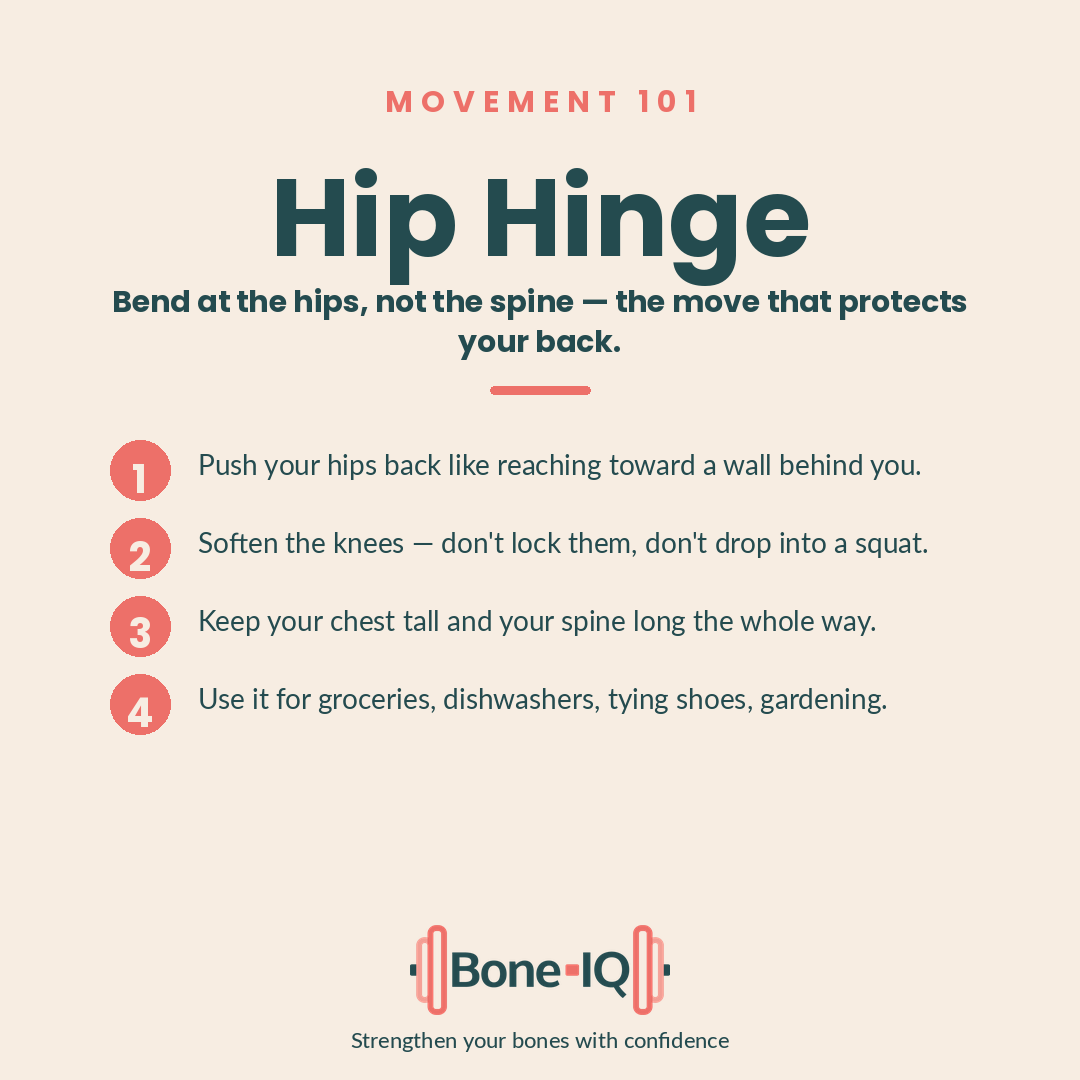
Do instead: The hip hinge. Push your hips back, soften your knees, and keep your chest tall, bending at the hips instead of the spine. For reaching down with one hand, use the modified golfer's reach: hinge from one hip while the opposite leg floats behind you as a counterweight.
3. Russian Twists and Twisting Machines
Why to avoid: Rapid, weighted spinal rotation, especially when taken to end-range, places concentrated stress on individual vertebrae. The risk multiplies when rotation combines with flexion (as in a Russian twist).
Do instead: Side planks. Train the obliques and core to resist rotation rather than create it. For golf or tennis, focus on hip-driven rotation rather than spine-driven.
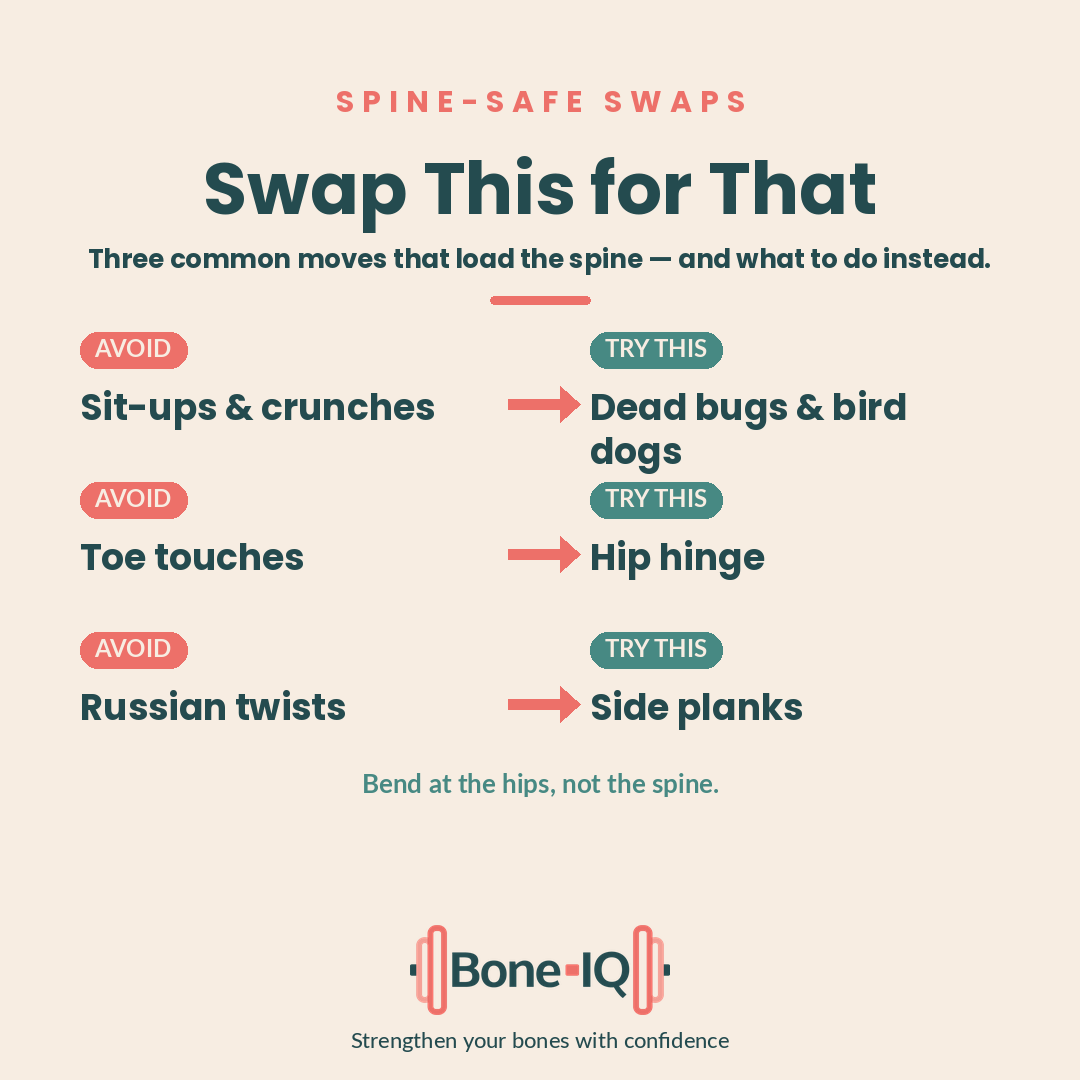
You don't have to give up core work with osteoporosis!
Use these swaps in your next workout to avoid flexing and twisting your spine.
4. Heavy Deadlifts with a Rounded Back
Why to avoid: The deadlift itself isn't the problem. The LIFTMOR trial showed postmenopausal women with osteoporosis can safely train deadlifts at high intensity under supervision. The risk is technique: loading the spine in flexion combines all five risk patterns at once.
Do instead: Learn the hip hinge with a dowel along your back before adding weight. Progress with lighter loads and supervision before going heavy. Trap-bar deadlifts can be a safer starting variation because they keep the load closer to your center of gravity, reducing forward flexion demand.
5. End-Range Yoga and Pilates Moves
Yoga and Pilates can have a place in bone health. Specifically, both can build balance, flexibility, and body awareness, however, traditional poses load the spine in exactly the ways BoneFit teaches us to avoid.
Common problem poses:
Deep forward folds — sustained end-range flexion
Plow pose and shoulder stand — loaded inversion with extreme flexion
Full Pilates roll-ups, teasers, and jackknives — weighted, repetitive flexion
Revolved triangle and deep twists — combined flexion + end-range rotation
Do instead: Modify forward folds with a hip hinge and bent knees. Replace roll-ups with modified bridges, dead bugs, and side-lying leg work. Twists should be initiated from the hips, not the spine. Look for instructors trained in BoneFit - you can search the registry on Bone Health & Osteoporosis Foundation site to find an expert in your area.
6. High-Impact Plyometrics Without Foundation
Why to avoid: Box jumps, drop jumps, and other high-impact plyometric work can build bone — but the safety record drops sharply when introduced without a strength foundation. The 2023 Clinical Practice Guidelines note that the safety and efficacy of impact exercise is uncertain in people at high fracture risk.
Do instead: Build strength first. Most people should complete 12–16 weeks of progressive resistance training before adding impact. Start with low-impact loading like step-ups, heel drops, and small skipping motions. Progress to vertical jumps only when strength and technique are solid.
The Underlying Spine-Safe Movement Principles
If you remember nothing else from this guide, remember these:
Bend at the hips, not the spine. The hip hinge is the most important single movement to learn for spine safety. Use it for groceries, dishwashers, tying shoes, and gardening — anywhere you'd normally bend forward.
Initiate rotation from the hips. Whether you're golfing, gardening, or reaching for a seatbelt, drive movement from the hips and let the upper body follow.
Avoid "cumulative" forward bending. A day of slumped sitting + sit-ups + deep yoga folds + bending to load the dishwasher adds up. Vary your positions, sit tall, and break up long flexed postures.
Practice spine-safe transitions. Most adults instinctively roll up from bed by curling forward. Instead, use the log roll instead (roll to your side, push up with your arms, swing legs over the edge).
If in doubt, modify. Almost every "risky" exercise has a safer version. A trained physical therapist or BoneFit-certified specialist can show you the alternative that fits your body.
What This Means for Your Workout Routine
Most people with osteoporosis or osteopenia don't need to be scared of exercise. They just need it tailored to their level. The most evidence-backed exercise stack for bone health, per the 2023 Clinical Practice Guidelines, is:
Progressive resistance training — to load bone and build muscle
Balance training — to reduce fall risk
Functional training — for real-world movements like sit-to-stand and carrying
Postural training — to align the spine and strengthen the back extensors
Walking is great. Yoga has a place. Pilates can help. But none of them replaces this four-pillar stack.
That's the gap we built Bone-IQ to close. We took the scientific evidence and built it into an app that meets you where you start and progresses with you.
Frequently Asked Questions
Can I still do yoga with osteoporosis?
Yes — with modifications. Avoid deep forward folds, deep twists, plow, shoulder stand, and headstands. Look for instructors trained in "yoga for osteoporosis." Standing poses, gentle backbends, balance poses, and mild lateral flexion are generally safe and beneficial.
Are sit-ups dangerous with osteoporosis?
Sit-ups load the spine in repeated, end-range flexion, the exact pattern most associated with vertebral wedge fractures. They aren't recommended for people with osteoporosis. Use dead bugs, bird dogs and planks instead.
Can I lift heavy weights with osteoporosis?
Yes — but start light and build up gradually. The LIFTMOR trial showed postmenopausal women with osteoporosis can safely train at up to 85% of their 1-rep max with proper supervision and progression. The key is technique: bend at the hips, keep the spine neutral, and progress gradually. Working with a BoneFit-certified trainer is strongly recommended for high-intensity lifting.
Should I avoid running with osteoporosis?
Running isn't automatically off limits, but it's worth assessing your fracture risk first. People with high fracture risk should generally avoid moderate-to-high impact activity until they've built strength. Walking, brisk walking, and progressive impact (step-ups, heel drops) are safer starting points.
How do I get out of bed safely?
Use the log roll: bend your knees with feet flat on the bed, roll onto your side as one unit (shoulders and hips together), push up with your bottom arm while swinging your legs over the edge, then pause sitting on the edge before standing.
Lexi Lewis is the co-founder of Bone-IQ, a science-backed bone health platform built after her mom's hip fracture diagnosis. Read more about our family story or download the Bone-IQ app to start your personalized plan.
Sources
Bone Health & Osteoporosis Foundation (BHOF) — BoneFit Specialist Training
Morin SN et al. Clinical practice guideline for management of osteoporosis and fracture prevention in Canada: 2023 update. CMAJ. 2023;195(39):E1333–E1348.
Watson SL, Weeks BK, Weis LJ, Harding AT, Horan SA, Beck BR. High-Intensity Resistance and Impact Training Improves Bone Mineral Density and Physical Function in Postmenopausal Women With Osteopenia and Osteoporosis: The LIFTMOR Randomized Controlled Trial. Journal of Bone and Mineral Research. 2018;33(2):211–220.
Daly RM, Dalla Via J, Duckham RL, Fraser SF, Helge EW. Exercise for the prevention of osteoporosis in postmenopausal women: an evidence-based guide to the optimal prescription. Brazilian Journal of Physical Therapy. 2019;23(2):170–180.
International Osteoporosis Foundation — patient and clinician education.